Faithful friends
October 12, 2026 · 5 min read
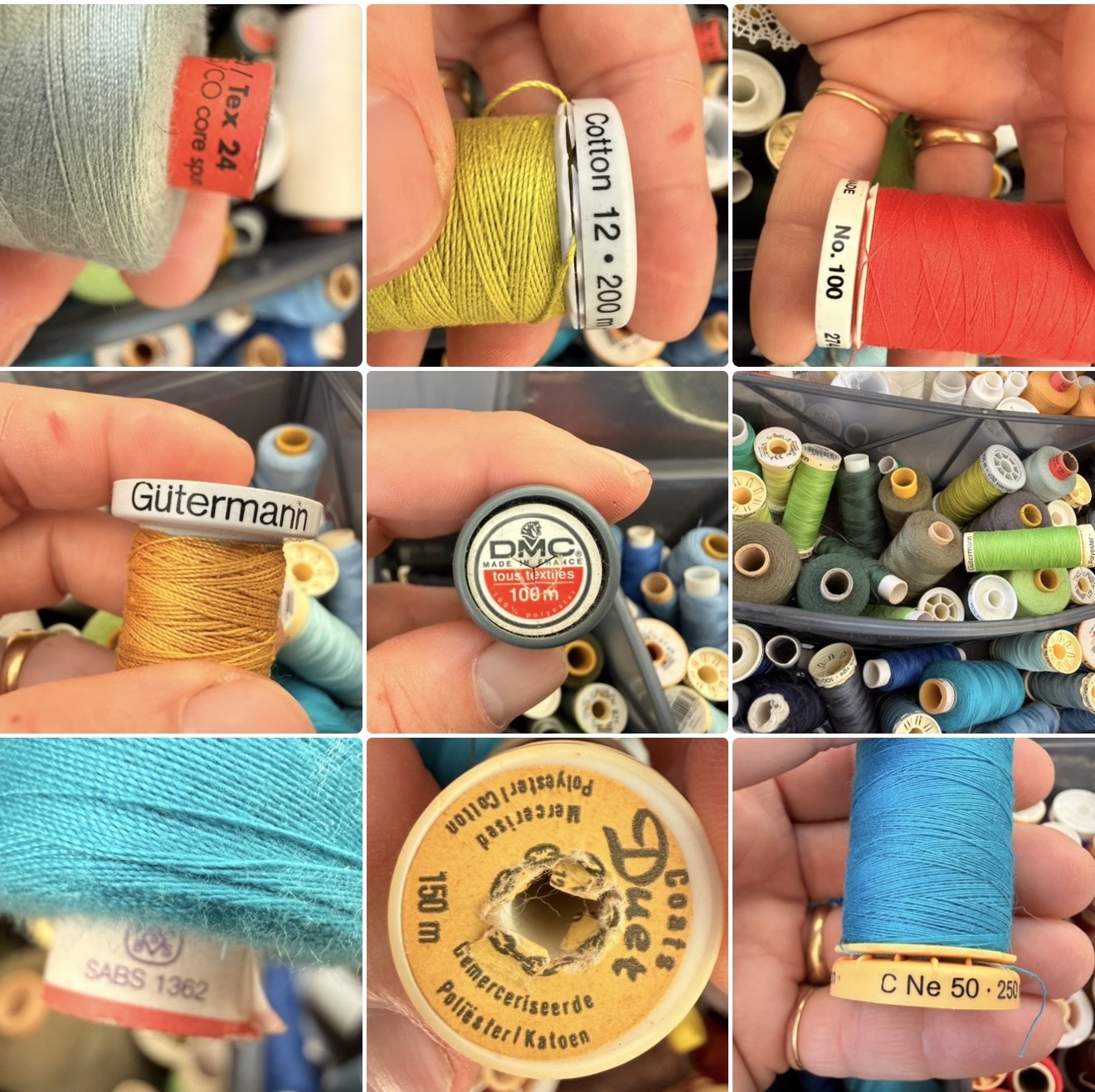
I am that person with the colour-coded thread box, and yet I feel my purposes are not serve 100% either. It should also be sorted by weight and type. Alas, that is what happens when you don’t subscribe to the excellent quiltmakers logic of buying cotton thread in shades of grey (here is looking at you Gütermann 618) early in your life.
Grey is fabulous, it blends so subtly with so many fabrics and really is much kinder to your pocket over time. Yes, I am not fibbing, next time before you rush off to buy new thread, visit your stash and pull out some grey threads, lay it against your fabrics, and you’d be surprised how many items you could potentially stitch with one colour.
I had a silent chuckle, because even though I have moved countries, interstate, and travelled frequently with my stash, some spools have made the journey through at least the last 40 years with me. Well done guys, you’ve got more staying power than some humans. Prize winning, “most faithful companion”, is a Coats Duet, made from the late 1970’s to early 1980’s. Followed by DMC Tous Textile made in the1980’s to 1990’s and last, but not least, a SABS standards labelled cone (if you know, you know), which would have been from the 1990’s. Who said thread is boring? Almost as much fun as buttons.
Of course, reading the spools is not as easy as selecting the thread in store where they are displayed nicely categorised. You can pick polyester or cotton, or a blend. Something for top stitching, something for that delicate silk, or embroidery. In the years gone by, mercerised cotton was pretty common. “Mercerised” means the cotton has undergone treatment with sodium hydroxide, yes the same stuff used to make soap, to enhance its strength, and improve dye absorption and smoothness.
And then there was Sulky. A name that was generally associated with Gutermann size 12, 100% cotton thread with a wool appearance – suitable for embroidery, and lace making. Of course number 12 threads can be used for quilting and sewing projects too. What Sulky really brought to the table, was thread as textile architecture. The thread chosen when nothing is left to chance – from high end lingerie, to couture where threads are not allowed to bleed when exposed to steam, or deteriorate when exposed to heat.
Before we rush on, let’s stop for moment with the significance of “12”. That number is a reference to the weight of the thread, but here the water gets pretty murky, really quickly. Thread weight was frequently referenced as wt, but wt has fallen away and weight is now expressed as just a number. (I tell my bathroom scale that too, “Weight is just a number, baby”.) The number 12, 40 or 50, etc, refers to how many kilometres of thread are required to make up one kg of thread. Right, so the lower the number, the thicker the thread.
The average general sewing thread is around 40. If it is a two or three ply thread, the number is followed by /2 or /3, as in 40/2, which technically means 40 km of 2 ply thread, equals 1kg.
Now here is a thought. If a spool of 100m thread, costs $3.75, how on earth can clothes be so cheap?
But let’s move on, because the weight issue does not stop there. You may see something like Tex 24 printed on a spool. The “Tex” measurement references the weight of 1 kilometre of thread. In other words, if 1kg of thread weighs 25 gm, it would be expressed as Tex 25. So the smaller the Tex number, the thinner/lighter the thread. A bit more logical perhaps?
Again, that is not the end of the story, because people like to complicate things.
Remember those awful pantihose/stockings/tights/leggings (whatever they were called in your part of the world), which had to be worn to school and special events? Its weight is described in denier. In French a denier was a small coin, worth one twelfth of a sou, but no, we could not stick to that either. Instead, 1 denier in textile terms means 1 gram per 9 km of thread. Yes, you read that right, gram per 9 kilometres. Pourquoi, mes amis? Nevermind, the outcome is that the higher the denier count, the thicker your hosiery filament.
When you ask your friend the garden spider what a filament is, she will say one continuous strand of fibre. Of course, not all threads are made up of filaments, some, like cotton, are made up of staples. Staples, well, much like the metal bits you use in a stapler, are lots of short fibre sections. Perhaps this term crept into the textile industry from sheep farming, where a staple is described as a naturally occurring lock, or cluster, of wool held together by cross fibres, in a sheep’s fleece. Some threads, for example core spun threads, which might be made up of a combination of filaments and staples, where the staples are wrapped around the filament.
Confused yet? Don’t worry, it is to be filed in the useless information category. What matters is that you pick a thread appropriate for your project. A thin thread won’t do for denim and a number 12, will certainly butcher silk. Just as thread, needle choices also matter. For a fine fabric, like silk, you would probably use a microtex needle, and it is unlikely a thick thread will go through the eye. The funny thing is, patterns never give a thread recommendation, because it will all depend on the fabric you choose for your project.
Next time you buy fabric, don’t forget to cross-check the needle guide. And use the grey thread. Happy sewing!